
News
Plymouth Argyle 1–2 Leeds United, 3 May 2025: Manor Solomon, 100 Points and Champions Again
Promotion was already secured, but the Championship title came down to the final day. Leeds fell behind at Plymouth, Willy Gnonto equalised, and Manor Solomon’s stoppage-time winner delivered 100 points and the league title in one of the club’s most dramatic recent finishes.

Manor Solomon, 100 Points and Champions Again
Promotion secured. The title still to win.
By the time Leeds United travelled to Home Park on 3 May 2025, the most important job of the season had already been completed. Daniel Farke’s side had confirmed promotion back to the Premier League after two seasons in the Championship. But promotion and the title are different things, and the league trophy was still waiting to be decided on the final afternoon.
Leeds and Burnley entered the last day level on 97 points. Burnley had built their campaign on an extraordinary defence, while Leeds had scored freely and won more matches. The two sides had separated themselves from the rest of the division, with Sheffield United behind them and the Championship’s automatic places already settled. Yet there was still one final question: who would be champions?
The arithmetic was simple, even if following it minute by minute was not. Leeds needed to match Burnley’s result. The Clarets hosted Millwall, while Leeds travelled to a Plymouth side whose relegation had already been confirmed. If both won, goal difference would decide the title. Leeds had the advantage in that column, but any slip while Burnley won would hand the trophy to Lancashire.
The own goal that made it difficult
Leeds started with ambition and came close through Sam Byram, whose header was saved by Conor Hazard. Plymouth, however, had their own reasons to compete. Their place in the division was gone, but they could still end the campaign with pride and make life uncomfortable for the visitors. Mustapha Bundu drove forward and struck a shot against the post; the rebound hit Byram and went into the net for an own goal in the 18th minute.
It was an awkward start, and it transformed the title race as it stood. Burnley were leading in their match as well, meaning Leeds were no longer in a position to match the Clarets. The visiting players knew the situation: promotion was secure, but if they were to lift the trophy, they had to find a response.
The first half became a test of patience. Leeds had the ball and looked for openings, but Plymouth defended with determination. Relegation had not made the home side willing extras in a title celebration; they wanted to end their season with something positive. Leeds were required to earn the result, and the score at half-time kept the championship in Burnley’s hands.
Gnonto brings Leeds level
Leeds returned from the interval with greater urgency. In the 53rd minute, Willy Gnonto finished from close range after a move down the left, turning in the kind of chance that had kept Leeds near the top of the scoring charts all season. It was an important goal for the Italian and a necessary one for the title race.
The equaliser did not settle anything. Leeds still needed a winner to ensure they matched Burnley’s result. The Clarets were winning at Turf Moor, and for a period the Championship trophy was effectively being carried towards Lancashire. Leeds continued to press, making changes in search of fresh energy, while Plymouth worked to preserve the draw that had been their reward for an organised performance.
The tension was unusual because Leeds had already won promotion. There was relief in knowing that the Premier League was secured, but there was also a growing awareness that this team had earned the right to finish the campaign as champions. A 100-point season would be an outstanding achievement; lifting the trophy would give it the proper ending.
Manor Solomon and the final minute
As the game entered stoppage time, Leeds were still level at 1–1. The sense of opportunity was turning into anxiety. Burnley were ahead against Millwall, and if the scores remained as they were, Leeds would finish second. It was the kind of final-day situation that makes every pass feel urgent and every missed chance feel as though it might be the last.
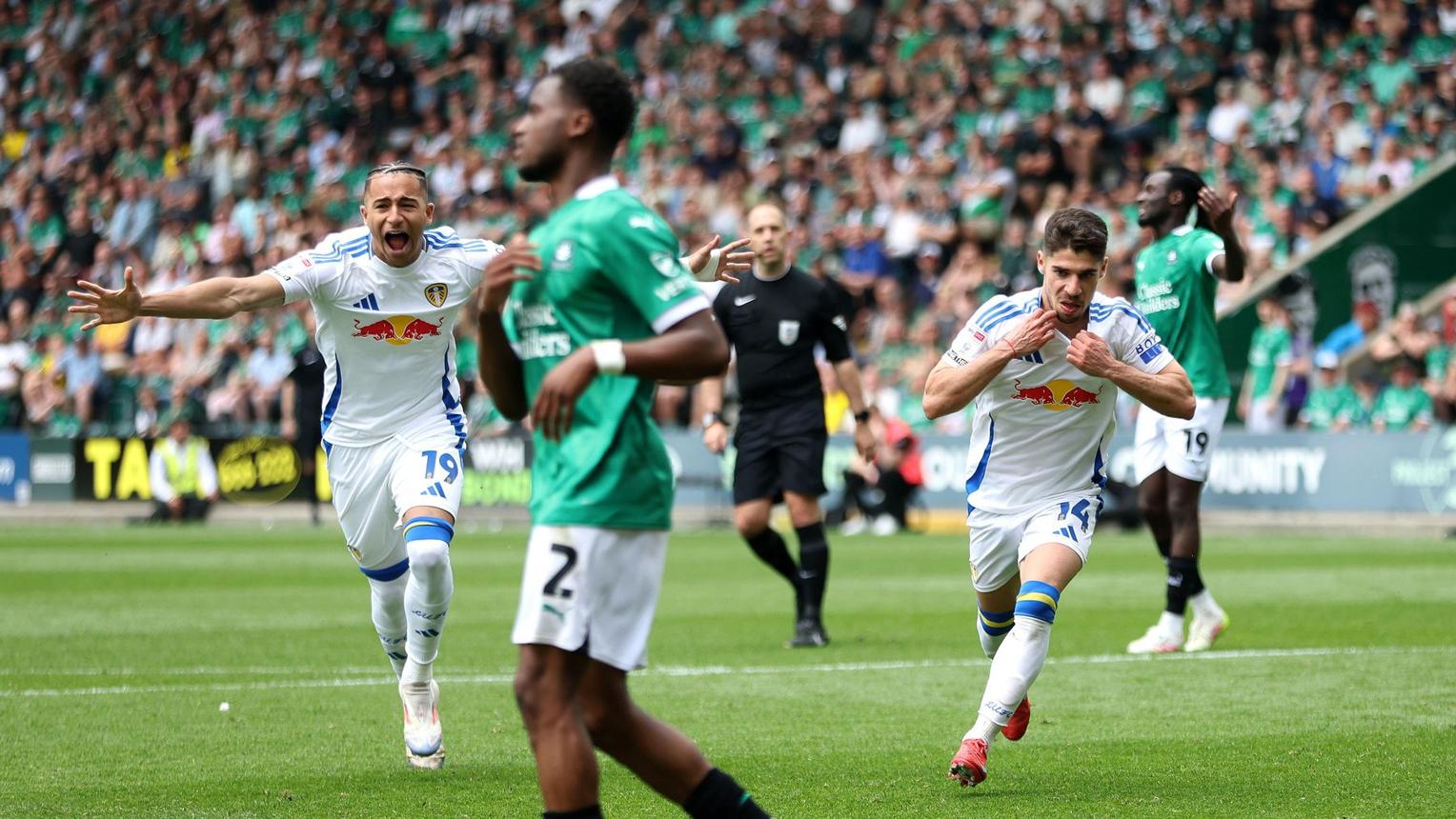
Then came the moment. Gnonto worked the ball down the left and fed Manor Solomon, who carried it into the area, shifted his body to create a shooting angle and drove a low finish into the bottom corner in the first minute of added time. It was a superb individual finish, but also the product of Leeds continuing to attack when a draw would at least have confirmed a strong season.
Solomon’s goal changed the title race in an instant. Leeds had matched Burnley’s result, and the superior goal difference would make them champions. The away end erupted. Players ran towards the supporters, the bench spilled into celebration and the championship that had appeared to be slipping away was suddenly Leeds’ again.
A 100-point title, not a footnote
The final whistle confirmed a 2–1 win for Leeds, and the table placed them first on goal difference. Both Leeds and Burnley finished with 100 points, the first time two teams had reached a century in the same Championship season. Leeds recorded 29 wins, 13 draws and four defeats, scoring 95 goals and conceding 30 for a goal difference of plus 65. Burnley also reached 100 points but finished with a goal difference of plus 53.
Those figures reveal the character of the two title challengers. Burnley were exceptionally difficult to score against, conceding only 16 league goals. Leeds combined defensive control with the division’s more prolific attack, scoring 26 more times than Burnley. They had not only survived the same points total; they had scored enough goals across the season to make the difference decisive.
The title race was exceptional. Sheffield United finished third on 90 points, while Birmingham City’s 111-point League One campaign meant three Football League clubs reached at least 100 points in the same season.
Farke finishes the job
For Farke, the title was a meaningful conclusion to a second season in which Leeds had recovered from the disappointment at Wembley in 2024. The defeat by Southampton had forced the club to spend another campaign in the Championship, and the manager had to rebuild the side while living with the memory of the missed opportunity. The response was emphatic: Leeds returned to the Premier League as champions, with a century of points and an attacking record that matched their status.
This was not simply the same team repeating a failed plan. The squad changed, the league presented different challenges and the pressure of being expected to secure promotion was constant. Leeds had to be more than the club that had fallen short in May 2024. They had to turn quality into results over 46 games, and then handle the unusual demand of a title race in which another side was keeping pace with them nearly to the end.
Manor Solomon’s contribution became the defining image, but the title belonged to the whole campaign. The points collected away from home in awkward matches, the goals from Gnonto, the defensive work of Ethan Ampadu and Joe Rodon, the control brought by Ao Tanaka and the consistency of the wider squad had all created the opportunity. The winner was the last piece, not the entire puzzle.
Why this match mattered
The Plymouth match mattered because it turned a successful promotion season into a title-winning one. Leeds could have returned to the Premier League without lifting the trophy, but the club and its supporters wanted to finish first. The own goal, Gnonto’s equaliser and Solomon’s late strike created a compressed drama that reflected the whole campaign: a strong side tested to the end, forced to answer a setback and ultimately rewarded for its persistence.
It also added an unusual detail to the club’s history. Leeds did not win the Championship by finishing a comfortable distance ahead. They matched Burnley’s 100 points and claimed the title on goal difference, after the final-day scoreline had seemed to be going against them. The season was statistically exceptional, but the ending was entirely Leeds: tense, emotional, never quite straightforward, and resolved in stoppage time.
When Solomon’s shot hit the net, a season’s worth of points and performances condensed into one moment. It was not a top-flight title like those of 1969, 1974 or 1992, but it was a championship that mattered enormously. Leeds had been relegated in 2023, missed out at Wembley in 2024, then returned a year later with 100 points and a trophy. That is a story of recovery, not merely arithmetic.
The Premier League awaited. The celebrations in Devon and West Yorkshire belonged to the same club that had learned so often how cruel football can be. For once, the last twist had gone Leeds’ way.