
News
Leeds United 4–5 Liverpool, 1991: The nine-goal thriller Leeds nearly rescued from nowhere
Four goals down at half-time, Leeds came within one of Liverpool in an extraordinary nine-goal First Division match. Lee Chapman scored a hat-trick, but the late fightback fell just short.

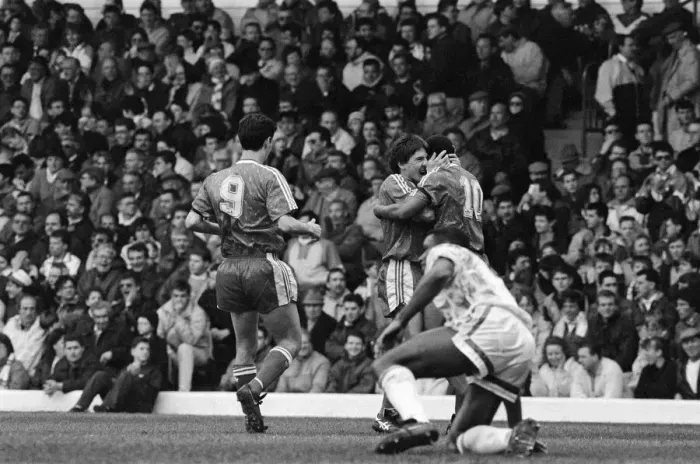
The nine-goal thriller Leeds nearly rescued from nowhere
Liverpool led 4–0 at half-time, yet Leeds turned the afternoon into a frantic chase for an improbable point. Lee Chapman's hat-trick came close to completing one of football's great recoveries, but this was a defeat that became a classic precisely because Leeds refused to disappear.
A 4–5 defeat does not usually become a cherished match in a club's history. At Elland Road on 13 April 1991, though, the scoreline tells only a part of the story. Liverpool were four goals ahead by half-time. Leeds United then mounted a furious response, scoring four times after the break and reducing the deficit to a single goal. They did not draw, and the final whistle confirmed defeat, but the match had already escaped the ordinary category of a league result.
Leeds were in their first season back in the top flight after winning promotion under Howard Wilkinson. They were doing far more than surviving. By spring they were competing near the top end of the table, with the mixture of experienced leadership and young talent that would form the core of the title-winning side a year later. Liverpool, meanwhile, remained one of English football's leading teams, even as the club moved through a period of transition after Kenny Dalglish's departure.
The opening half was brutal from a Leeds perspective. Ray Houghton opened the scoring, Jan Mølby converted a penalty, David Speedie added a third and John Barnes made it four. Liverpool's movement and finishing exposed Leeds repeatedly. At half-time, the visitors were in complete control and the home crowd faced the prospect of watching their team be dismantled in front of them.
The second half began the match Leeds supporters still talk about. Lee Chapman scored to make it 4–1, and Carl Shutt then made it 4–2. For a moment, the game appeared capable of doing the impossible. The home side had found energy and belief, and the crowd could feel the change. Yet just as the comeback gathered force, Barnes scored his second to restore Liverpool's three-goal cushion at 5–2.
Leeds were not finished. Chapman scored again, then completed his hat-trick late in the match, making it 5–4 and leaving Liverpool clinging to the result. The striker's three goals gave the crowd something to roar at even as the clock ran down. Leeds had transformed a dead contest into one that demanded Liverpool defend every attack, and the last minutes carried the strange tension of a match that had already produced more drama than anyone could reasonably expect.
The equaliser never came. Liverpool left with the points, Leeds with the frustration of having started too late, and everyone present with a story. The attendance was 31,460, the largest league crowd at Elland Road for a considerable period. This was a fixture with the history of Leeds and Liverpool behind it, but the drama was entirely its own: a match of two sharply different halves, the first controlled by Liverpool and the second driven by Leeds' refusal to accept the inevitable.
It would be easy to romanticise the comeback and ignore the defensive collapse. That would miss why the game is interesting. Leeds were an ambitious side learning the demands of the First Division, and the match exposed both their potential and their vulnerability. They could attack with real conviction, but against the very best teams a poor spell could leave them with too much to do.
Chapman's contribution belongs in the foreground. A hat-trick in a nine-goal match is memorable in any circumstance; to score three times while trying to rescue a side from a four-goal deficit is something different. Shutt's goal helped change the emotional temperature of the stadium, while Barnes' second showed how difficult it is to recover completely when an opponent can hurt you again at the other end.
The defeat did not derail Leeds' season. They finished fourth in 1990–91, an extraordinary outcome for a newly promoted side and the platform for the title race that followed. The Liverpool game became one of the more vivid illustrations of the team Wilkinson was assembling: capable of thrilling people, capable of making mistakes, and not short of the nerve to keep playing when the match appeared lost.
That is the point of including this match among those that mattered. Not every important story is about a trophy being lifted or a promotion being confirmed. Sometimes a match matters because it explains a team to its supporters. Leeds lost 5–4, but in the second half they gave Elland Road a performance that was almost as memorable as a victory.