
News
Coventry City 3–2 Leeds United, 1987: The Wembley dream that slipped away
Leeds came within reach of Wembley in 1987, but Coventry turned a semi-final lead into a 3–2 extra-time defeat. A cup run that lifted Leeds ended in one of the era’s most painful near-misses.

The Wembley dream that slipped away
Leeds had not reached an FA Cup semi-final for a decade, and for a few glorious minutes at Hillsborough the final seemed within reach. Coventry turned the tie around, Leeds dragged it back, and a late extra-time goal ended the dream.
There are defeats that hurt because a team has been outclassed, and defeats that hurt because you can see the destination from where you are standing. Leeds United's 3–2 extra-time defeat to Coventry City at Hillsborough belonged firmly to the second category. For a club still trying to work its way out of the Second Division, Wembley was no longer an abstract memory of the Don Revie era. It was close enough to touch.
Billy Bremner's Leeds had reached the FA Cup semi-final for the first time in ten years. The club had spent much of the intervening period trying to recover its footing after the decline that followed Revie's departure and relegation from the First Division in 1982. The Cup offered a different route to national attention, and a day at Hillsborough brought a sudden sense that the old name might once again command the biggest stage.
Leeds started with the conviction of a side that understood what was at stake. David Rennie rose to head them ahead in the first half, giving the travelling support reason to believe. Coventry were First Division opponents, but they were not an untouchable force, and Leeds defended their advantage with considerable effort. As the minutes passed, the Wembley possibility became more tangible.
Coventry changed the mood after the break. Substitute Micky Gynn made an immediate impact, equalising before Keith Houchen put the Sky Blues in front. Leeds were suddenly facing the familiar old danger: one moment of promise turning into the sort of afternoon that leaves a season defined by what might have been.
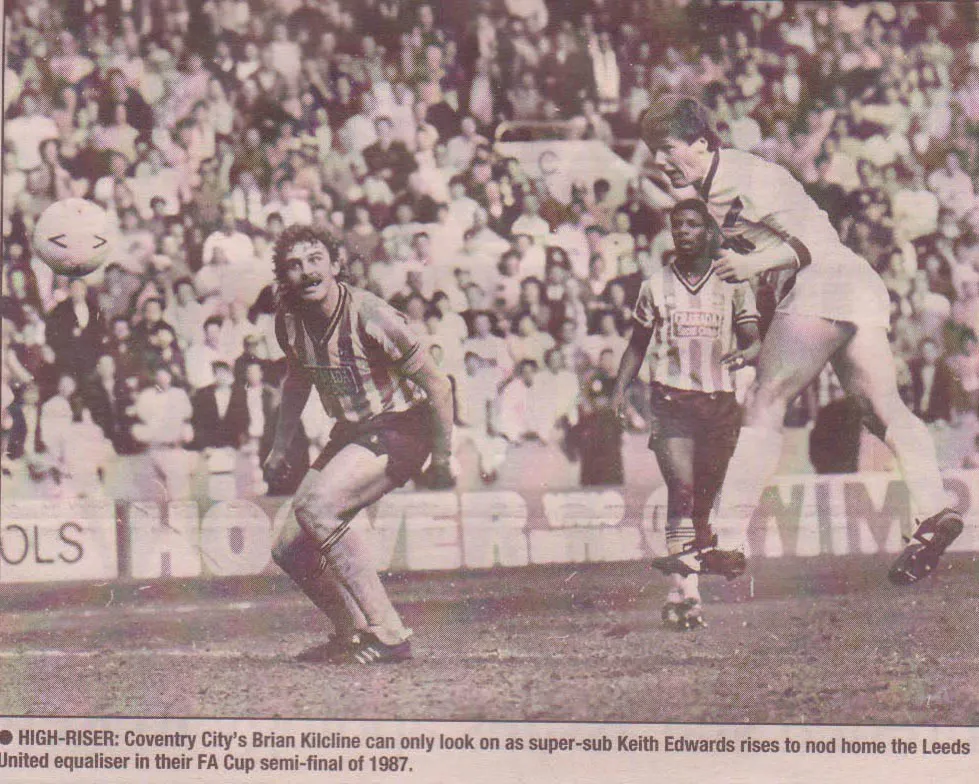
But Leeds did not fold. Keith Edwards scored late on to make it 2–2 and force extra time, restoring a measure of hope and setting up a frantic finish. This was not a side prepared to accept its fate simply because the balance of the match had shifted. Edwards's goal was the response of a team still fighting for the day, and of supporters who had stayed with them through plenty of less promising afternoons.
Then, in extra time, Dave Bennett finished a Coventry attack to make it 3–2. The final blow arrived after Leeds had twice found a way back into the contest. Coventry would go on to win the FA Cup, beating Tottenham Hotspur in the final, while Leeds were left to return to league business with Wembley gone again.
The scoreline tells the story of the goals; it does not quite capture the emotional movement of the match. Leeds had led, been overtaken, rescued the tie, and then lost it in the extra period. The match was a reminder that a cup run can lift a club beyond its everyday circumstances, but can also make the eventual return to reality more painful.
In isolation, a semi-final defeat is not a turning point in the same way as a promotion or a championship. In the context of Leeds in the 1980s, however, this was a rare high-profile opportunity to remind the country of the club's standing. The disappointment was magnified by what followed: only weeks later, Leeds would suffer another extra-time defeat, this time in the Second Division play-off final replay against Charlton Athletic.
That is why this semi-final belongs in Matches That Mattered. It was not the end of Leeds' story, but it concentrated the frustrations of the era into one afternoon: the quality to compete, the courage to recover, and the fine margins that kept the club below the level to which its history and supporters aspired. Wembley would have to wait.