
News
Manchester United 2–1 Leeds United, 23 April 1977: Wembley Dreams Ended at Hillsborough
In the 1977 FA Cup semi-final at Hillsborough, Leeds United found themselves undone by a devastating opening quarter-hour. Goals from Jimmy Greenhoff and Steve Coppell put Manchester United in control, and though Allan Clarke pulled one back from the penalty spot after missing an earlier crucial one-on-one, the great Revie-era spine slipped closer to the end of an era.

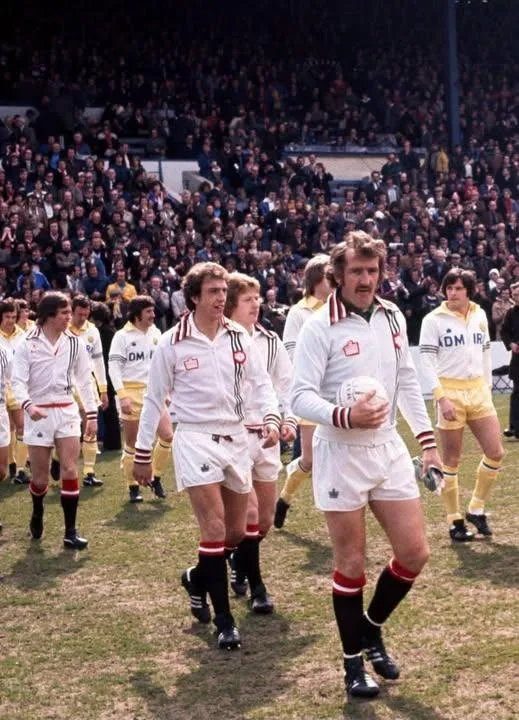
Wembley Dreams Ended at Hillsborough
The end of an era meeting an old rival
On Saturday 23 April 1977, 55,000 supporters crammed into Hillsborough for an FA Cup semi-final that carried all the historic weight of English football’s most bitter modern rivalry. For a decade, Leeds United had defined domestic dominance, reaching Wembley with ruthless regularity and claiming silverware through discipline, power, and tactical brilliance. But by 1977, the great side built by Don Revie was visibly ageing. Jimmy Armfield was now in the managerial hotseat, trying to manage the gradual transition of a legendary squad without losing its competitive soul.
Manchester United, meanwhile, were emerging as a vibrant, youthful counterpoint under Tommy Docherty. They possessed pace on the flanks and an attacking verve that contrasted sharply with Leeds’ experienced, battle-hardened veterans. Yet semi-finals at neutral venues had long been territory where Leeds felt entirely at home. Instead, what unfolded in Sheffield became a painful reminder that time waits for no club.
Two early blows and a missed lifeline
The contest was effectively shaped within the opening fifteen minutes. Leeds started sluggishly, struggling to cope with the zip and energy of Manchester United’s midfield. In the 7th minute, Jimmy Greenhoff found space to fire past David Stewart, exposing a defensive fragility that had rarely been associated with Leeds in their pomp.
Before Leeds could gather their composure, the second blow arrived. Gordon Hill’s shot was deflected by Frank Gray, sitting up invitingly for Steve Coppell to rifle home from 20 yards out in the 15th minute. Two goals down, Leeds looked uncharacteristically devoid of momentum.
Yet, true to their pedigree, Leeds manufactured a golden chance to drag themselves back into the contest before the interval. Eddie Gray slipped a brilliant pass through to Allan Clarke, sending the legendary striker one-on-one with Alex Stepney. It was a scenario Leeds fans had witnessed thousands of times with utter confidence. Unbelievably, ‘Sniffer’ dragged his shot wide of the post. It was a moment of disbelief that seemed to drain the remaining conviction from the white shirts.
Clarke converts too late
Without needing to play with fluent authority, Manchester United comfortably managed the second half, snuffing out any tentative Leeds surges. Tony Currie showed flashes of his sublime class in midfield, attempting to knit together attacks, but Leeds lacked the cohesive support structure around him.
Hope flickered briefly in the 70th minute when Leeds were awarded a penalty, and Allan Clarke made no mistake from the spot to reduce the deficit to 2–1. But it proved to be nothing more than a consolation. As the final whistle blew, the Leeds end stood in the cold April rain, watching their Wembley dreams disappear with a whimper.
Why this match mattered
This semi-final defeat was not merely an afternoon of missed chances; it was symbolic of a wider transition. The invincible aura that had protected Leeds through the late 1960s and early 70s was fading. The core of world-class players was growing older, and replacements of equal calibre were difficult to secure.
While Manchester United marched on to Wembley, Leeds returned north to face the reality of a changing football landscape. The 1977 semi-final demonstrated how quickly momentum can stall when a legendary squad reaches the end of its natural cycle, marking another step along the road of the club’s slow 1970s decline.