
News
The Roses Rivalry in Numbers: Leeds United vs Manchester United Head-to-Head
Explore the Leeds United–Manchester United rivalry through the numbers: all-time results, memorable Elland Road victories, the 1992 title race and the players who crossed between the clubs.
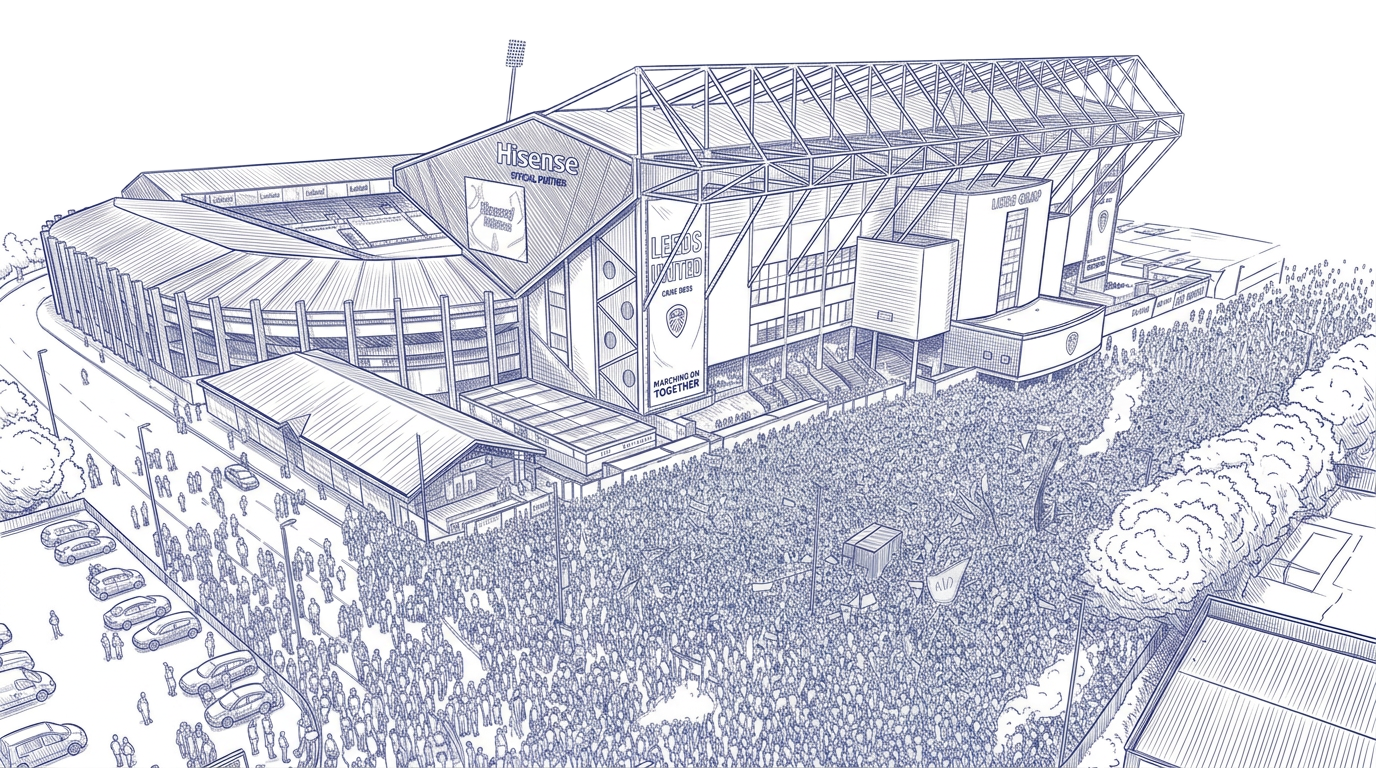
Leeds United’s rivalry with Manchester United is about more than geography or the old Wars of the Roses. It is a contest built from decades of football, trophies, transfers, bruising matches and the changing fortunes of two clubs whose stories have repeatedly intersected.
Leeds United versus Manchester United is more than a fixture. It is one of English football’s most emotionally charged rivalries, a contest shaped by regional pride, contrasting club histories, generations of supporters and a long list of matches that have made the relationship impossible to treat as ordinary.
The name “Roses rivalry” connects the fixture to the historic symbolism of Yorkshire’s white rose and Lancashire’s red rose. It is a useful shorthand, though the modern football rivalry is not simply an unbroken continuation of the Wars of the Roses. Its intensity has been built through football itself: the rise of Don Revie’s Leeds, Matt Busby’s Manchester United, the 1991–92 title race, the transfer of players between clubs and the very different fortunes of the two sides since the Premier League began.
The head-to-head record
According to the Leeds Ins & Outs head-to-head archive, Leeds and Manchester United have played 117 competitive matches across all competitions, with Leeds winning 27, drawing 40 and losing 50. Leeds have scored 117 goals and conceded 170. The most recent meeting at the time of writing was the 1–1 Premier League draw at Elland Road on 18 October 2026.
| Metric | Record in Leeds Ins & Outs archive |
|---|---|
| Competitive meetings | 117 |
| Leeds United wins | 27 |
| Draws | 40 |
| Manchester United wins | 50 |
| Leeds goals scored | 117 |
| Leeds goals conceded | 170 |
| Most recent meeting (at time of writing) | Leeds United 1–1 Manchester United, 18 October 2026 |
Why the rivalry became so intense
Leeds and Manchester are separated by a relatively short journey, but the clubs developed different identities during the second half of the twentieth century. Manchester United’s rise under Busby was associated with a celebrated young team, the Munich air disaster and European ambition. Revie’s Leeds became a fiercely organised, hard-edged and successful side whose style and reputation attracted intense debate.
The 1960s and 1970s provided the rivalry with footballing substance. The two clubs competed for the First Division title and major cups, while the personalities around them became part of the story. Matches were often physical and fractious, but they were also contests between teams of genuine quality. The label “Dirty Leeds” stuck, while United carried the status and support of a club whose history and ambitions were already enormous.
The rivalry also has a regional story. Yorkshire and Lancashire identities are real parts of the cultural landscape, but it would be too neat to suggest the modern hostility comes directly from medieval conflict. For supporters, the history is football history: who won, who lost, who crossed the divide, who celebrated at whose ground and who still gets mentioned whenever the two teams meet.
The matches that live longest in Leeds memory
Leeds United 5–0 Manchester United, 1930
One of Leeds’ largest league victories over United came at Elland Road on 20 December 1930, when Leeds won 5–0. The result belongs to an earlier era of the fixture, before either club’s modern identity had fully formed, but it remains part of the historical ledger and gives the rivalry a reminder that heavy defeats have travelled in both directions.
Leeds United 5–1 Manchester United, 1972
The 5–1 Elland Road victory in 1972 is one of the iconic Leeds results. It came during Revie’s great era and was a statement of superiority over a rival that Leeds supporters were particularly keen to beat. It also helps explain why the modern rivalry retains such a long memory: a famous scoreline can remain a reference point for half a century.
The 1991–92 title race
The championship race of 1991–92 brought the rivalry into sharp focus. Wilkinson’s Leeds had only recently returned to the First Division and were competing with Ferguson’s Manchester United for the league title. Leeds won 3–2 at Sheffield United in their penultimate fixture; United then lost at Liverpool, confirming Leeds as champions of the final First Division season before the Premier League began. It was a defining moment for Leeds and another long wait for a title for United.
Leeds 1–0 Manchester United, FA Cup, 2010
Jermaine Beckford’s goal at Old Trafford gave Leeds a famous FA Cup win while they were in League One. The division gap made the result more than a cup upset: it was a reminder that the rivalry did not depend on league position. Leeds supporters had travelled in numbers and left with one of the great modern memories of the fixture.
The 2020s: a rivalry resumed in the Premier League
Leeds’ return to the Premier League in 2020 brought a fresh generation into the fixture. Manchester United won 6–2 at Old Trafford in December 2020, an emphatic result in the early part of Leeds’ return. Leeds also produced a 0–0 draw at Elland Road in 2021 despite being reduced to ten men after Liam Cooper’s red card. The two fixtures showed the contrast between the sides’ resources, but also the intensity that the match retains.
In April 2026, Leeds won 2–1 at Old Trafford, with Noah Okafor scoring twice in a significant away victory. It was Leeds’ first league win at Old Trafford since 1981, according to the match records commonly cited for the fixture. On 18 October 2026, the teams drew 1–1 at Elland Road, with Bryan Mbeumo scoring for United before Dominic Calvert-Lewin equalised. Those results give the rivalry a contemporary chapter rather than leaving it as a museum of old memories.
The players who crossed the divide
Direct transfers between Leeds and Manchester United have often carried an emotional charge beyond the fee. In some cases a player moved because the opportunity was right; in others the move became a symbol of the changing balance between the clubs.
Johnny Giles moved from Manchester United to Leeds in 1963 and became one of the defining players of Revie’s side, a gifted midfielder whose influence helped turn Leeds into a major force. Gordon Strachan, who joined Leeds from United in 1989, became a key figure in Wilkinson’s promotion and title-winning teams. Their stories are reminders that a player can cross a rivalry and become deeply identified with the club that receives him.
The movement in the other direction has been more difficult for Leeds supporters to accept. Joe Jordan and Gordon McQueen left Leeds for Manchester United in 1978. Éric Cantona moved from Leeds to United in 1992, soon becoming a central figure in Ferguson’s eventual Premier League dynasty. Rio Ferdinand’s move in 2002 for a widely reported £29.1m fee was a British record at the time, and Alan Smith’s transfer in 2004 came after the emotional scenes of Leeds’ relegation. Smith had been mobbed by supporters at the final home game; his move to United in the weeks that followed made it one of the most painful departures in the club’s modern history.
More recently, Daniel James went the other way, joining Leeds from Manchester United in 2021 after a transfer that had nearly happened two years earlier. The deal gave Leeds a reminder of the rivalry’s continuity: even in the modern game, where transfers are conducted across a global market, moving between these two clubs carries a significance that a standard deal does not.
The rivalry as a record, not just a feeling
The all-time numbers give the rivalry shape. Leeds’ 27 wins show that they have had their share of memorable days; the 50 defeats reflect Manchester United’s longer periods of dominance and their larger haul of trophies across the modern era. Forty draws underline how many games have been tight or unresolved. The goal figures reveal the same broad imbalance while providing a starting point for deeper analysis by venue, competition and decade.
The raw record, however, cannot tell you which match matters most to a supporter. A league result in December can be remembered because it changed a title race. A cup win can outlive a whole season because it happened at Old Trafford. A 5–1 victory can become shorthand for an era. A transfer can be remembered long after the fee has been forgotten because it crossed the emotional line between the clubs.
The next chapter is never just another fixture
Leeds and Manchester United are not the same clubs they were under Revie and Busby, or Wilkinson and Ferguson. The financial landscape has changed, the Premier League has become a global business and players move between leagues and countries with a frequency that would have seemed extraordinary in the 1960s. But the rivalry still compresses all of that history into 90 minutes.
For Leeds supporters, beating Manchester United is never merely three points. It reconnects the present with the teams of the past, with the 5–1, with the title race of 1992, with Beckford at Old Trafford and with every player who crossed the divide. For United supporters, Leeds remains a fixture whose intensity has survived long periods when the clubs were in different divisions.
The Roses rivalry can be measured in wins, draws, defeats, goals and transfers. At the time of writing, Leeds Ins & Outs records 117 competitive meetings, with 27 Leeds wins, 40 draws and 50 defeats. That is the answer the numbers give. The reason it still matters is written in a much older language: local pride, history, resentment, admiration, and the certainty that the next meeting will carry everything that came before it.
Sources
Leeds United official history of the rivalry · Leeds Ins & Outs head-to-head archive · Leeds United official honours · BBC on Rio Ferdinand’s transfer · 11v11 Manchester United vs Leeds, 13 April 2026 · The Guardian, Leeds 1–1 Manchester United, 18 October 2026
Leeds Ins & Outs • Draft for editorial review • 21 October 2026