
News
How many league titles have Leeds United won?
Leeds United have won the English top-flight title three times. From Don Revie's great teams of 1969 and 1974 to Howard Wilkinson's final First Division champions of 1992, discover the facts, heartbreak and memories behind the club's greatest league triumphs.

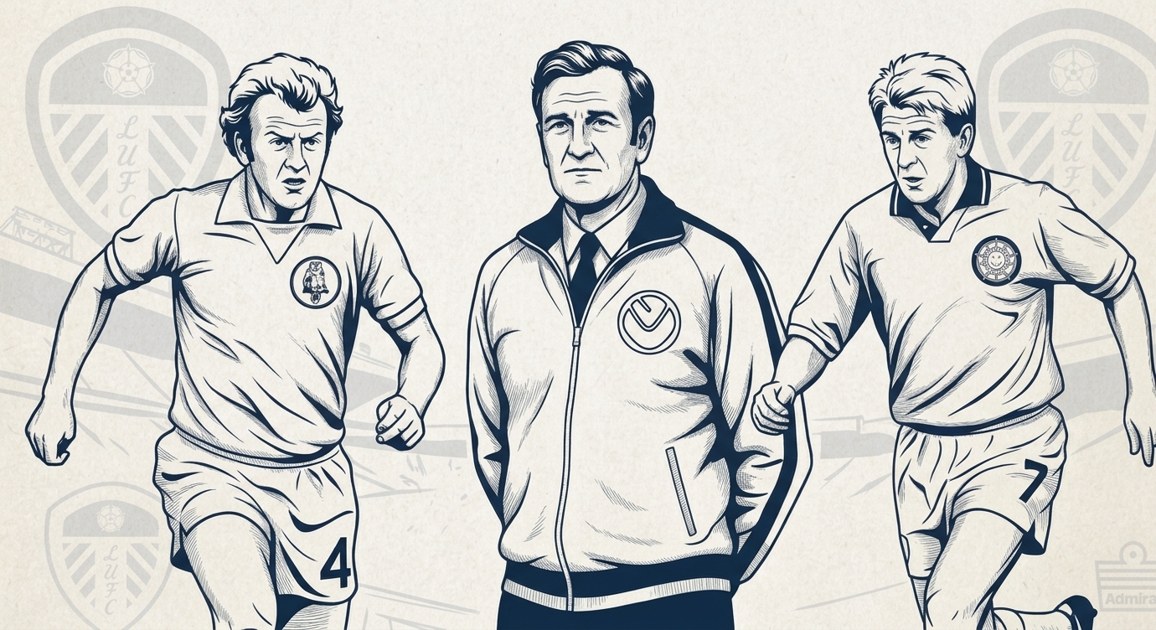
Leeds United have won three English top-flight league titles: 1968–69, 1973–74 and 1991–92. The first two came under Don Revie, the architect of the club's greatest era, while the third was won under Howard Wilkinson in the final season of the old Football League First Division, immediately before the Premier League began.
Those three championships came in very different circumstances. The first announced Leeds United as the dominant force Revie had spent years constructing. The second confirmed that his team could rise above the weight of expectation and the bitter disappointments that had accumulated around it. The third rescued the club from a long decline, brought the city back to the summit of English football and gave Leeds supporters one last championship before the football landscape changed forever.
Three titles might not sound like a vast collection for a club that has spent long periods among England's leading sides. Manchester United, Liverpool and Arsenal have won substantially more top-flight championships. Leeds have endured generations between their greatest triumphs, periods in which the club has slipped into the second division, dropped into League One and watched other clubs occupy the stage that once belonged to them.
But the number alone tells only part of the story.
At Leeds United, a title is not an achievement that sits quietly in a cabinet, insulated from everything that came before or after it. It becomes part of the argument about the club: what it has been, what it should be, what it deserves, what it has thrown away and what it might yet become. Each generation inherits the memories of the last, along with the peculiar conviction that Leeds can be magnificent when the rest of the football world has decided to expect something else.
The song has always understood it better than any league table. We've been through it all together, and we've had our ups and downs.
The ups have included three championships of England. The downs have included enough calamity to make those triumphs feel almost improbable in retrospect. Through both, the supporters have remained. That is the significance of Marching On Together: not a promise that everything will turn out well, but a declaration that the outcome will not decide whether you belong.
A Leeds title is never just a trophy. It is the culmination of a season's work, the vindication of a manager's vision, the reward for the players who carry it out and the fulfilment of something shared by a city and its supporters. It is also a reminder of how difficult it is to reach the summit, and how little the game guarantees that you will ever get there again.
What counts as a Leeds United league title?
Before looking at the three championships, it is worth clearing up an occasional source of confusion.
Leeds United's three top-flight titles were won in the Football League First Division, in 1968–69, 1973–74 and 1991–92. The First Division was England's highest league until the formation of the Premier League in 1992. The 1991–92 championship therefore made Leeds the final champions of the old First Division, not Premier League champions.
The club has also won the second-tier championship five times: in 1923–24, 1963–64, 1989–90, 2019–20 and 2024–25. Those are major achievements in their own right, but they are distinct from winning the top division.
The distinction matters because football is full of titles, and not all titles mean the same thing. Winning promotion from the Championship can transform a club's finances, ambitions and future. Winning the top division means finishing above every other club in the country. For Leeds, that has happened three times.
The full record is available in the club's official honours list, while the Leeds Ins & Outs historical season archive lets you explore the club's league finishes, managers, goals, results and honours across more than a century of football.
The three championships are separated by years, different footballing cultures and very different versions of Leeds United. They are connected, however, by one striking feature: each required the club to overcome the consequences of its own past before it could reach the top.
1968–69: Don Revie's Leeds become champions of England
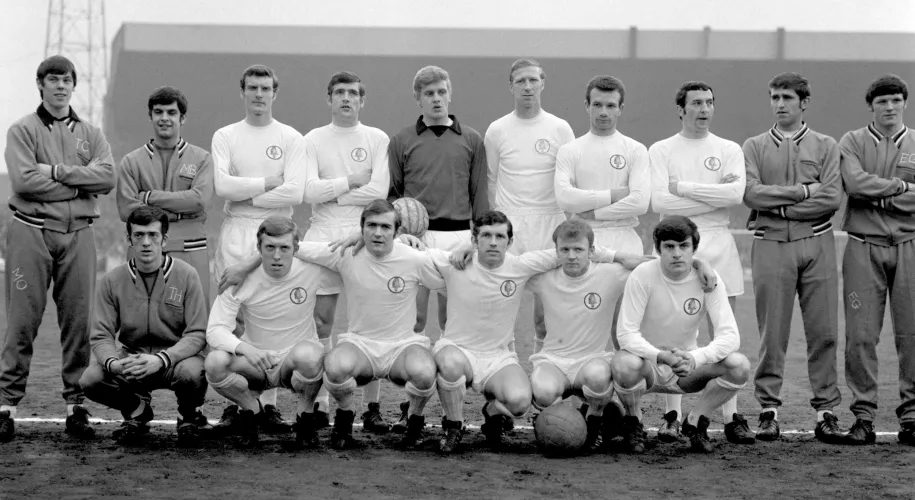
There was nothing inevitable about the rise of Don Revie's Leeds United.
When Revie took charge in March 1961, the club was in a precarious position. Leeds were a second-tier side with financial difficulties, a team that needed rebuilding and a city whose football ambitions had yet to be matched by sustained success on the pitch. In the final match of the 1961–62 season, a victory helped Leeds avoid relegation to the Third Division. The distance between that club and the team that would soon challenge for the biggest honours in England was considerable.
Revie's achievement was to see a future that was not yet visible to anyone else.
He built around a mixture of local talent, astute recruitment, technical ability and an uncompromising collective identity. He paid close attention to details that could appear insignificant individually but became decisive when repeated across a season. Training, preparation, tactical organisation, recruitment and the culture inside the dressing room all served the same purpose. Leeds were to become a team in which everyone understood his responsibility to everyone else.
Revie was a builder of habits as much as a manager of footballers. He wanted a side that was prepared, disciplined and difficult to break down, but that could also pass, move and hurt opponents. He created a sense of collective identity that extended beyond the pitch. The familiar rituals and close-knit atmosphere around the team were part of an attempt to make Leeds a unit rather than merely a squad of individuals.
There were talented footballers, naturally. Billy Bremner was the fierce, restless centre of the side. Jack Charlton brought authority and defensive experience. Norman Hunter combined aggression with intelligence. Johnny Giles, signed from Manchester United, became a footballer of exceptional craft and influence. Peter Lorimer possessed a shot that could turn a routine attack into something the opposition goalkeeper would remember for years. Eddie Gray offered a different kind of magic, gliding past defenders in a way that seemed almost at odds with the steel surrounding him.
But Revie was building more than a collection of good players. He was building a football club that expected to win.
The years of almost
Leeds won promotion to the First Division as Second Division champions in 1963–64. Their arrival among the established clubs was immediate and emphatic.
In 1964–65, they finished level on points with Manchester United but lost the championship on goal average. They also reached the FA Cup final, losing to Liverpool after extra time. The following season, Leeds again finished runners-up in the league, this time behind Liverpool. In 1966–67, they reached the Inter-Cities Fairs Cup final. In 1967–68, they won both the League Cup and the Inter-Cities Fairs Cup, yet finished fourth in the league.
Success was accumulating, but the biggest prize kept slipping away.
Those seasons shaped the meaning of the eventual championship. Leeds were not a newly promoted side who enjoyed an unlikely run and surprised everyone. They were a team that had repeatedly demonstrated its ability to compete with the best, then had to live with the disappointment of falling just short.
Finishing second once is painful. Doing it twice in succession, while losing a major cup final, leaves a different kind of mark. It gives a team a reason to believe it is capable of winning, but also a reason to fear that the final step may prove impossible.
The experience did not make Leeds cautious. It made them more determined to impose themselves.
The label Dirty Leeds had already taken hold in the press and in the football establishment's treatment of Revie's side. Leeds could be physical, uncompromising and aggressive; they were hardly the only team in an era when football could be a decidedly rough business. But the label became part of the story told about them, sometimes obscuring the organisation, technical quality and tactical intelligence that made them so difficult to beat.
For Leeds supporters, the caricature became part of a familiar relationship with the wider game: the sense that the club had to win its arguments as well as its matches.
It would be too easy to claim that every setback was the product of bias or that every rival was conspiring against Leeds. Football rarely offers explanations so convenient. But it is fair to say that Leeds developed an identity in which outsiders' judgements were treated with suspicion and success was expected to do the talking.
A season of ruthless consistency
By 1968–69, Leeds had already won significant trophies. The league championship remained the missing piece.
Revie would strengthen his attack further in the summer of 1969 by signing Allan Clarke from Leicester City for a British transfer record. Clarke joined after the first championship, adding another source of goals and movement to a side that had already established its defensive resilience and midfield authority.
The result was a campaign of extraordinary consistency. Leeds won 27 of their 42 league matches, drew 13 and lost only twice. They scored 66 goals and conceded just 26, finishing six points clear of Liverpool. They collected 67 points under the two-points-for-a-win system then in operation and went unbeaten at Elland Road throughout the league season.
Those numbers deserve to be read in their own historical context. A modern reader might look at 67 points and assume it was a solid but unspectacular return. Under the scoring system of the time, it represented a formidable season. The significance was not a comparison with modern 100-point campaigns, but the distance Leeds created between themselves and their rivals while losing so rarely.
Their defence supplied the foundation. Charlton and Hunter were central to it, with goalkeeper Gary Sprake and players such as Paul Reaney and Terry Cooper contributing to a team built to make opponents work for every chance. Bremner provided the intensity. Giles brought control and invention. Gray and Lorimer could change the shape of a game. Mick Jones offered the goals.
The team also possessed an extraordinary capacity to carry its form from one season into the next. Leeds' unbeaten run in the First Division eventually stretched to 34 matches across the end of the 1968–69 campaign and the beginning of the following season. The championship was therefore not the end of a lucky streak. It formed part of a longer period in which Leeds were one of the most difficult teams in England to beat.
Revie's side did not need to perform like a travelling circus to win football matches. They could dominate a game, grind out a result or defend a lead with grim efficiency. The beauty of the team was partly in its variety, and partly in how rarely it abandoned its principles under pressure.
On 28 April 1969, Leeds travelled to Anfield to face Liverpool, the team still capable of challenging for the title. A defeat could have reopened the race. Leeds drew 0–0 and secured their first First Division championship.
It was a fitting way to win it. There was no last-minute goal to provide a convenient Hollywood ending, no spectacular celebration that could obscure the work of the previous months. There was a difficult away match, a disciplined performance and a result that finished the argument.
Liverpool's players and supporters acknowledged the achievement. Whatever the hostility Leeds had encountered elsewhere, there was no denying what Revie and his players had done.
For the club, the title confirmed that years of building had delivered the prize. For the supporters, it meant seeing their team become champions after coming so close in previous seasons. They had spent years waiting for the moment when all that promise could be converted into something permanent.
A league title does not make every earlier disappointment worthwhile. It does, however, change how those disappointments are remembered. The near-misses become part of the journey rather than evidence of a limit.
Leeds had reached the top, and the club's greatest era was still unfolding.
What made the 1968–69 title special was the scale of the achievement and the way it was earned: 42 matches, 27 victories, just two defeats, the entire league season unbeaten at home and a championship secured against the side most capable of taking it away. This was not a miracle. It was the completion of a project.
Read the full season story: 1968–69: Leeds United win their first English top-flight title.
1973–74: The redemption of Revie's champions
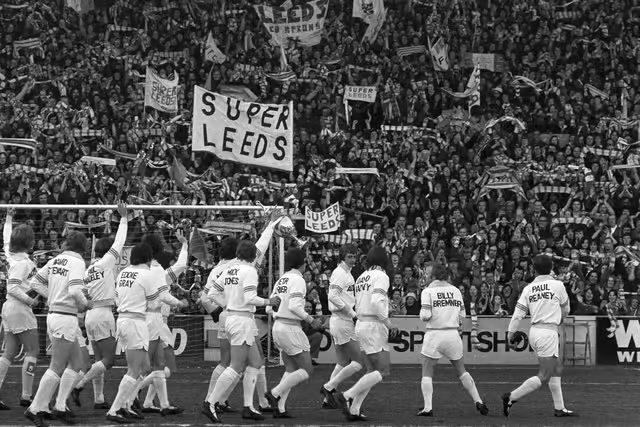
If the first title announced Leeds United, the second defined their standing.
By the early 1970s, Revie's team had become one of the strongest sides in English football. They had won the First Division, the League Cup and the Inter-Cities Fairs Cup, and they had established themselves as regular contenders for the major domestic and European honours. Yet their reputation was inseparable from the finals they lost, the arguments surrounding their approach and the persistent feeling that their achievements were never entirely allowed to speak for themselves.
The 1972–73 season was a particularly cruel example. Leeds finished third in the league, lost the FA Cup final to Sunderland and were beaten by AC Milan in the European Cup Winners' Cup final. The European final remains contentious in Leeds history, but the result itself was plain enough: another major opportunity had passed without the reward the players wanted.
The response came in the form of the 1973–74 First Division campaign.
Twenty-nine games without defeat
Leeds began the season with the assurance of a team that knew exactly what it was. They went 29 league matches unbeaten before losing 3–2 away to Stoke City on 23 February 1974. By then, they had established a position from which they could absorb the occasional setback without surrendering control of the championship race.
The final league record was 24 wins, 14 draws and four defeats from 42 matches. Leeds scored 66 goals, conceded 31 and finished five points ahead of Liverpool, with Derby County third.
The 29-match unbeaten start remains one of the defining achievements of the season. It was not simply a long run of good fortune. It reflected an experienced side that understood how to manage a campaign, how to control matches, how to respond when games became awkward and how to turn draws into valuable points when a victory was not available.
There is a romantic temptation to imagine great football teams winning every match. Real title-winning teams have to do something harder. They must keep collecting results across months of changing conditions, injuries, suspensions, difficult trips and opponents determined to make life uncomfortable. The ability to avoid defeat can be just as important as the capacity to destroy an opponent.
Leeds possessed both.
Bremner remained the side's emotional and competitive centre. His leadership was never a matter of standing apart from the team. He was in the middle of the struggle, setting the tempo and refusing to let standards slip. Giles supplied intelligence and balance in midfield. Lorimer could strike fear into goalkeepers from distance, while Gray's dribbling offered a different route through defences. Clarke and Jones provided the goals. Norman Hunter brought defensive bite, and Gordon McQueen, whose arrival added height and authority, became an important part of the side's defensive strength. David Harvey provided security in goal.
The team could be forceful, but it was not merely forceful. It was technically accomplished, tactically organised and experienced enough to understand the rhythm of a long season.
The familiar image of Revie's Leeds is often one of hard men and hard tackles. That image has its roots in reality, but it misses the point of the football. A side does not remain unbeaten for 29 league matches through aggression alone. It does so because it knows where its next pass should go, how it intends to defend and what every player needs to do when the original plan is interrupted.
The burden of being Leeds
The championship was also an answer to the disappointment of the previous year.
Leeds supporters had already experienced the pain of losing finals. The team had been accused of falling short when it mattered, and rival fans had plenty of material with which to make that case. The cup defeats of 1973 were especially hard to accept because they came alongside a league campaign in which Leeds were still a major force.
The 1973–74 title did not erase those defeats. Nor did it settle every argument about Revie's football or the club's public image. What it did was establish, beyond reasonable dispute, that Leeds could respond to disappointment with a campaign of sustained excellence.
There is something recognisably Leeds about that response. The club's supporters have never had the luxury of treating their history as a neat procession of victories. The triumphs are too widely separated, the disappointments too vivid and the sense of what the club could achieve too deeply embedded to allow that.
Leeds supporters remember the wins, naturally. They also remember the teams that were nearly good enough, the late goals conceded, the finals lost and the seasons in which the possibility of success seemed to narrow at precisely the wrong moment. That is not unique to Leeds, but it has become a distinctive part of the club's emotional inheritance.
A title in 1974 mattered because it was a title won by a side that had heard all the arguments before. Revie's players had been accused of failing to convert their quality into enough silverware. They responded by winning the league with four defeats in 42 matches.
They had done what every great team is eventually asked to do: they had won again.
The end of the Revie era
There was a bittersweet quality to the achievement, because Revie left Leeds at the end of the season to become England manager.
The departure brought the most successful period in the club's history to a close. Under Revie, Leeds had won two First Division titles, the FA Cup, the League Cup and two Inter-Cities Fairs Cups. They had also reached the finals of major European competitions and established a culture that would continue to shape the club long after Revie had left.
The title-winning side had not suddenly appeared in August 1973. It was the result of more than a decade of development, including the promotion of 1964, the heartbreak of 1965, the first championship of 1969 and the years in which Leeds became one of the principal forces in English and European football.
Revie departed with his standing as Leeds' greatest manager strengthened by a final championship. He left behind a team of exceptional quality and a standard against which every subsequent side would be measured.
The transition that followed demonstrated just how difficult it would be to replace him. Brian Clough's reign at Leeds lasted only 44 days in 1974. His appointment collided with the loyalties, relationships and culture Revie had established inside the dressing room. Clough was an outstanding manager, but he was not Revie, and his methods and authority never took hold at Elland Road.
The episode would become one of English football's most famous managerial stories, immortalised in The Damned United. It also carried a serious lesson for Leeds. The club's success had not come simply from buying good players and finding a suitable formation. It rested on a relationship between manager, players and institution that could not be replaced by changing the name on the office door.
Great managers do not leave an empty chair; they leave a shadow. Their successors inherit the players, the expectations and the demand that Leeds continue to behave like champions.
For the supporters, the 1973–74 title was both a culmination and a beginning. Revie's team had delivered its second championship. The next era would have to find its own way to live up to it.
Read the full season story: 1973–74: Leeds United's record-breaking championship campaign.
The years between: From the summit to the wilderness
The history of Leeds United is often told through Revie's triumphs and Wilkinson's championship. The years separating them are just as important to understanding what those titles mean.
Revie's departure was followed by the turmoil of Clough's brief reign and then a succession of managerial changes as the old team gradually broke up. Leeds reached the European Cup final in 1975 under Jimmy Armfield, losing to Bayern Munich, but their league position deteriorated. The club eventually fell out of the First Division in 1982.
It was a shocking decline for a club that had spent much of the previous two decades among the country's leading teams.
The Second Division years were long and often dispiriting. Leeds continued to attract a loyal following, but the club had lost its position at the top of English football and struggled to regain it. The 1987 play-off final defeat to Charlton Athletic was another painful example of how difficult the final step could be. In the replay at St Andrew's, Leeds took the match into extra time before losing 2–1. Promotion would have to wait.
When Howard Wilkinson arrived in 1988, he was not simply trying to win a few more matches. He was tasked with restoring the club's structure and ambition, getting Leeds promoted and building a side that could survive in the First Division rather than return to the second tier at the first opportunity.
The first step came in 1989–90, when Leeds won the Second Division title and secured promotion. It was a significant achievement in its own right, ending eight years away from the top flight. But Wilkinson's ambition extended further.
He wanted Leeds to return to the First Division as a club with the foundations to become a force again.
That distinction would prove decisive. Leeds were not promoted merely to participate. They were promoted to compete.
1991–92: Wilkinson, Manchester United and the last champions of the old First Division
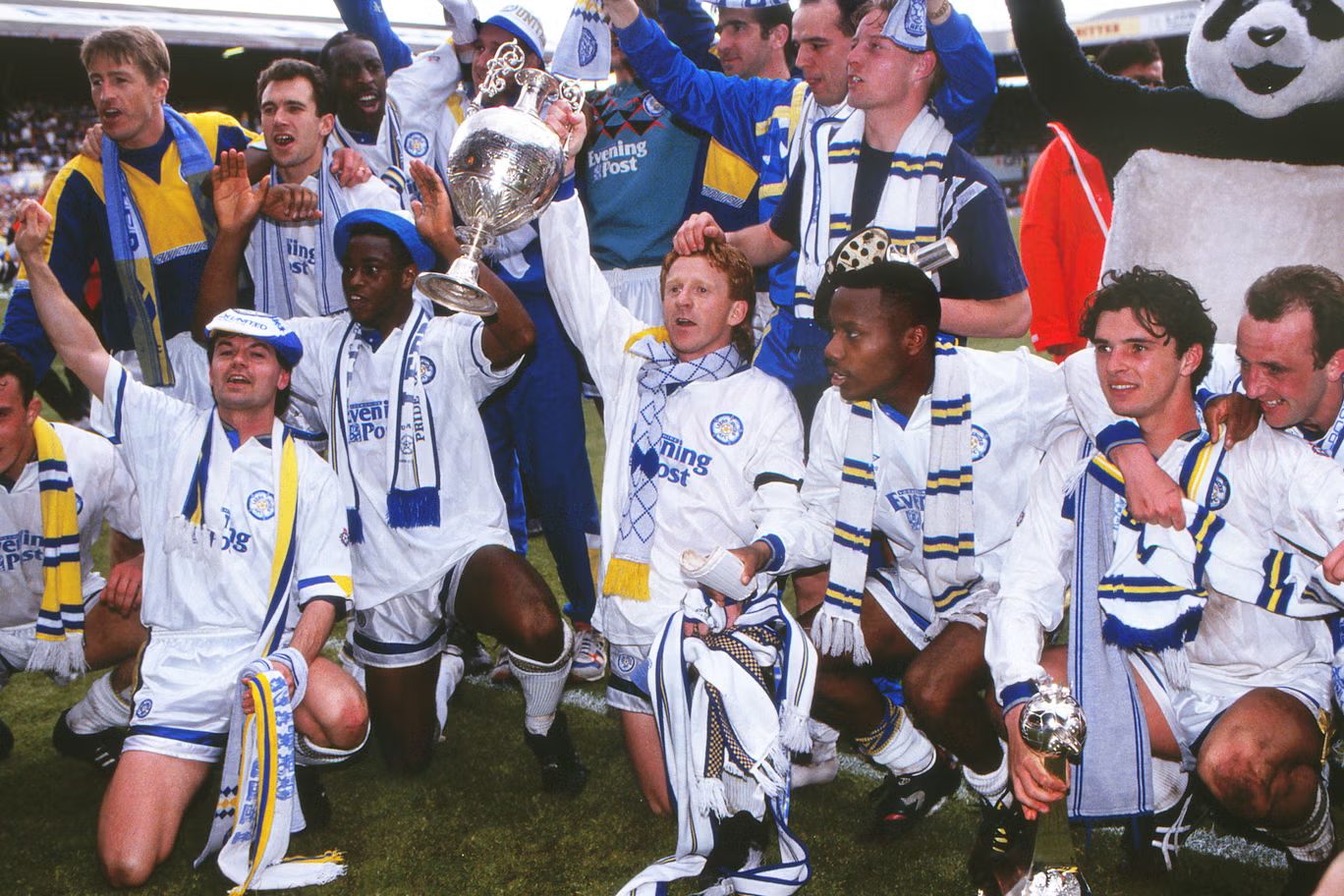
The third Leeds United top-flight title was different from the first two in almost every respect.
Revie's championships had been won by an established team that had grown together over many seasons. Wilkinson's title was the result of a rebuild. The club had been in the Second Division only two years earlier, and the team that lifted the championship in 1992 contained a mixture of experienced professionals, ambitious recruits and young players developing into leading footballers.
It was a project based on organisation and planning as much as personality.
Wilkinson was sometimes called "Sergeant Wilko", a nickname that reflected his disciplined approach. He wanted his players fit, structured and clear about their responsibilities. Leeds needed a team capable of competing against the biggest clubs without relying on a single source of inspiration.
The 1989–90 promotion campaign had created the platform. The next season, Leeds finished fourth in the First Division, a remarkable return from the second tier. Their 1991–92 campaign began with the expectation that they could improve again, but the standard of competition was formidable.
Building a team capable of winning
Gordon Strachan was central to Wilkinson's plans. The experienced Scottish midfielder brought authority, competitive spirit and an understanding of the demands of a title challenge. David Batty offered energy and discipline, while Gary Speed was emerging as a player capable of making a contribution at both ends of the pitch. Gary McAllister supplied technical quality and creativity in midfield.
At the back, Tony Dorigo's arrival strengthened the defence. John Lukic provided experience in goal, while players including Chris Fairclough, Chris Whyte and Mel Sterland contributed to a side that developed a strong collective identity.
Up front, Lee Chapman was crucial. He scored 16 league goals during the championship season, giving Leeds a consistent focal point and a reliable source of goals. Rod Wallace offered pace and movement, and the squad's different attacking options allowed Wilkinson to adapt to the demands of individual matches.
The team's success did not come from one player transforming everything. It came from having the right blend of qualities across the pitch. Strachan could lead; Batty could protect; McAllister could create; Chapman could score. Wilkinson had assembled a side in which the players' strengths complemented one another.
The achievement was especially striking because Leeds had only recently returned to the division. They had to compete with clubs possessing long-established top-flight squads and greater recent experience of title races. They did so by building a balanced team, improving on the previous season and remaining consistent when the campaign reached its decisive stage.
Manchester United and the title race
Manchester United were the principal rivals in the closing weeks of the season, adding a particular edge to the championship.
The relationship between the two clubs was already bitter. The rivalry had historical and geographical roots that predated the modern Premier League, and the prospect of Leeds finishing above Manchester United for the English championship gave the contest an added significance for supporters.
United were pursuing a title of their own under Alex Ferguson. Leeds, meanwhile, were trying to complete their return from the second tier by becoming champions of England. It was not a contest between a settled giant and an implausible newcomer, but it was a meeting of clubs travelling in different directions.
Leeds had spent years trying to restore a status that had once seemed permanent. Manchester United were seeking to end their own long wait for a league championship. By the spring of 1992, the two stories had become entwined.
The league table tells the essential story. Leeds finished with 82 points from 42 matches, recording 22 wins, 16 draws and four defeats. They scored 74 goals and conceded 37. Manchester United finished second on 78 points.
Leeds were not the most spectacular team in every match, nor did they need to be. They were a team capable of winning, drawing and managing the difficult periods of a long season. They had found the consistency required to finish above every rival.
The signing of Éric Cantona in February added another attacking option and a touch of flair to the run-in. He scored three goals in the remainder of the campaign, contributing to the final stage of the title push. He would later become an iconic figure at Manchester United, a twist that has given the signing a life of its own in football history. In the moment, however, Cantona was a Leeds player helping Leeds pursue the championship.
The story of 1991–92 is sometimes reduced to that irony. It deserves a more complete telling. Cantona mattered, but he arrived in a team that had been built over several seasons and was already in contention. Strachan, Batty, McAllister, Speed, Chapman and their teammates had created the opportunity long before Cantona walked through the door.
The afternoon the title was secured
Leeds entered the final games knowing that the championship was within reach, but it still had to be won.
On 26 April 1992, Leeds travelled to Sheffield United for a match that would become one of the defining afternoons in the club's history. Rod Wallace helped set Leeds on their way, and the side eventually won 3–2 in a tense contest.
The result left the title within reach, but Manchester United still had a chance to extend the race. Then came the decisive result elsewhere: Manchester United lost 2–0 at Liverpool. Leeds were champions.
The significance of that sequence is easy to overlook when a championship is recited as a statistic. The final result was dependent on more than Leeds' own performance. Supporters had to wait for news from another ground, hoping that the rivals' result would complete the work.
That is football in its most nerve-racking form. The team has done what it can, but the outcome is not entirely in its hands. Every pass, every chance, every minute elsewhere becomes part of the same match. When the final news arrives, the season changes in an instant.
Leeds had won the title in the final season of the Football League First Division. The following campaign would begin under the newly formed Premier League, with English football entering a different commercial and sporting era.
That timing has added to the championship's historical importance. Leeds were not merely champions; they were the last club to win the old First Division before the Premier League era began.
For supporters who had lived through the decline of the 1970s and the wilderness years of the 1980s, the moment meant something beyond the league table. Leeds had returned to the summit of English football. The years of rebuilding, the promotion campaign, the improved fourth-place finish and the tense title run-in had led to the same destination reached by Revie's team.
It was the club's third top-flight title and its first since 1974. It would also be its last for at least the next generation of supporters.
What Wilkinson built beyond the title
The championship was not the only part of Wilkinson's legacy.
His work included rebuilding Leeds after the Second Division years, developing the club's infrastructure and putting in place a longer-term vision for youth development. The academy at Thorp Arch would later contribute important players to the first team, while the club's return to the top flight created the platform for further European campaigns.
The title did not guarantee endless success. Football is not so generous, and the years that followed brought their own challenges. But Wilkinson had restored something fundamental: the belief that Leeds could be a serious top-flight club again.
That achievement is sometimes overlooked in the shadow of the trophy itself. Winning the championship was the great moment, but it was also the outcome of a broader reconstruction.
There is a lesson in the contrast with Revie. One manager built a team that grew into a dynasty; another rebuilt a club that had lost its place. Both understood that the title had to be earned through the work that came before the season reached its decisive weeks.
The near-misses: Five runners-up finishes, and a club shaped by what might have been
Leeds' three titles do not exist in isolation. They sit alongside a remarkable sequence of near-misses that has helped define the club's relationship with success.
Leeds finished runners-up in the First Division in 1964–65, 1965–66, 1969–70, 1970–71 and 1971–72. The first two came during Revie's transformation of the club; the next three came during the peak years of a side that was already one of the country's strongest. In the later period, Leeds won other major trophies, but the league title kept eluding them.
The 1964–65 campaign was especially cruel because Leeds lost the title on goal average after finishing level on points with Manchester United. They also lost the FA Cup final to Liverpool. The following season brought another second-place finish, this time behind Liverpool. Those results formed the backdrop to the breakthrough in 1968–69.
The seasons after that first championship brought a different kind of frustration. Leeds finished second to Everton in 1969–70 after pursuing a treble, then lost the 1970 FA Cup final to Chelsea after a replay and exited the European Cup with a semi-final defeat to Celtic. In 1970–71 they finished runners-up to Arsenal, and in 1971–72 they were second to Derby County. The years brought triumphs elsewhere, including the 1972 FA Cup, but the league was often the prize that slipped away.
This is what makes the Leeds record so distinctive. There is no simple progression from promise to domination to permanent success. The club reached the summit, fell short repeatedly, reached it again and then went decades without a third title.
For supporters, the near-misses are part of the memory, not a footnote to the trophies. They explain why the championships are talked about in such detail: how the team played, who scored, which rival lost, what happened in the final weeks and how long people had waited.
A title win can become more precious when the club has known how difficult it is to win one. But that should not romanticise the defeats. Losing a final is painful. Finishing second is painful. Seeing a promising team break up, or watching the club decline while rivals prosper, is painful. Leeds supporters do not need to pretend otherwise for those experiences to matter.
The history has shaped a particular mixture of pride and impatience. Leeds fans can speak with deep affection about the great teams of the past while remaining unsatisfied with the club's present. They can celebrate a promotion while knowing that it is not the same achievement as a top-flight title. They can remember the highest points without accepting that history alone should be enough.
It is an identity sustained partly by memory, partly by argument and partly by the certainty that the next good side might finally be the one.
Why Leeds have never been just another football club
It would be tempting to explain the connection between Leeds supporters and their club through geography alone. Leeds is a major Yorkshire city with a strong local identity, and Elland Road has long been a gathering point for generations of supporters. But geography does not fully explain the intensity.
The club's identity has been shaped by contrast: with rivals, with the football establishment, with the expectations created by the Revie era and with the distance between what Leeds has achieved and what supporters believe it is capable of achieving.
The rivalry with Manchester United is the clearest modern expression of that contrast, particularly in the 1991–92 title race. But it also sits alongside an older Yorkshire football culture, in which regional pride, local rivalries and the desire to represent Leeds well have all played a part.
Revie's side helped make Leeds a national force, but it also gave the club a reputation that was never uncomplicated. The team could be admired for its organisation and quality, yet criticised for its approach and temperament. That tension became part of the mythology.
It is important not to turn the story into a conspiracy theory. Every club has grievances, and football supporters are rarely short of reasons why the world is against them. The Leeds experience is more interesting than that. It is about a club that became so formidable, and so disliked in some quarters, that hostility was absorbed into its own identity. Being underestimated or disliked became a source of solidarity. Success was the answer, but the argument never entirely disappeared.
Leeds supporters do not need to believe that every referee, journalist or rival has something against them to recognise that the club has often been misunderstood, caricatured or judged through the lens of its reputation. The old Dirty Leeds label is an obvious example. It tells us as much about how the team was perceived as it does about how it played.
The Square Ball has written with particular insight about Leeds' history, supporters and cultural memory. Its account of the 1992 Marching On Together re-release captures something of the relationship between football, music and a city that was ready to celebrate after years of waiting. The song did not need to explain why the title mattered. The timing did that for it.
A championship is always a collective achievement, even when individual players become its public face. It belongs to the manager, the coaching staff, the players, the people who work at the club and the supporters who carry its identity between generations. The supporters do not score the goals, but they give the club its meaning beyond the match itself.
That relationship becomes particularly visible when the team is struggling. Anyone can enjoy a winning side. Remaining attached when the club is relegated, financially troubled or unable to fulfil its potential requires something different. It is not proof that suffering makes a club superior to its rivals. It is proof that football loyalty is not a simple transaction in which affection is exchanged for success.
The title-winning years become the moments that bind the generations together. A grandparent remembers 1969. A parent remembers 1992. A younger supporter experiences the promotion campaigns and the thrill of seeing Leeds return to the top flight. The details differ, but each generation inherits the same club and the same song.
That is why three championships can carry so much emotional weight. They are not three isolated events from a history book. They are three occasions when the team gave a wider community the strongest possible reason to believe.
Why Leeds' titles matter more because there have been only three
The scarcity of Leeds' top-flight titles is part of their significance, although it should not be confused with a claim that the club has been unsuccessful in every other respect.
Leeds have won the FA Cup, the League Cup and the Inter-Cities Fairs Cup. They have competed in major European finals and produced teams that were among the best in the country. They have also won five second-tier championships, each with its own consequences for the club's future.
Yet the top-flight title remains the ultimate measure of a league season. The list of clubs that have won it repeatedly is dominated by sides with long periods of sustained success. Leeds had their own period of dominance under Revie, then one final championship under Wilkinson. What followed was an absence that stretched across the rise of the Premier League, the financial troubles of the early 2000s, relegation to League One and the slow process of rebuilding.
The financial crisis and subsequent decline of the early 2000s were a particularly harsh reminder of how quickly a club's circumstances can change. A team that had reached the Champions League semi-finals in 2001 was relegated from the Premier League in 2004 and then fell into the third tier. By 2007, the club was in administration and received a 15-point deduction on entering League One. For supporters who had grown up with the idea of Leeds as a major club, the contrast was severe.
That history is not included here to suggest that the club's modern supporters should live permanently in the past. It is included because it explains why past success is valued so fiercely. A title is not a guarantee that the club will remain powerful. It is a moment of achievement that must be earned again by a future team, under future conditions.
The modern game also places the old titles in a different frame. Since 1992, the Premier League has become a global competition with vast financial differences between clubs and a commercial structure unlike that of the old First Division. Leeds' 1991–92 title cannot be claimed as a Premier League championship, but its place in English football history is secure. It was the final title before that transition, and it was won by a club that had only recently escaped the Second Division.
The three titles are separated by five years between the first and second, and 18 years between the second and third. Each came with a different story, but all three required Leeds to prove that it could stand above the country's leading sides.
It is that achievement, rather than the raw number, that gives each championship its power.
The other titles: A wider history of winning
The three top-flight championships form the centre of this story, but Leeds United's wider league history adds important context.
The club's first league title came in 1923–24, when Leeds won the Second Division and secured promotion to the top flight. It was an early sign of the club's capacity to establish itself, although the decades that followed included relegations and promotions before Revie's arrival transformed its fortunes.
Revie himself won the Second Division title in 1963–64, an achievement that laid the groundwork for the First Division successes of 1969 and 1974. Under Wilkinson, the Second Division title of 1989–90 brought Leeds back to the top flight and created the conditions for the 1991–92 championship.
Marcelo Bielsa's 2019–20 side ended a 16-year absence from the Premier League by winning the Championship. That campaign gave supporters a modern team to cherish, with a distinct identity and a manager whose methods transformed the club's performances. The 2024–25 Championship title under Daniel Farke then delivered another promotion as champions, returning Leeds to the Premier League once more.
These achievements do not diminish the three First Division titles. They underline the different ways a championship can change a club's direction. The second-tier successes restored Leeds to the top flight, sometimes after long periods away. The three top-flight titles confirmed that Leeds were the best team in England.
Readers can explore these seasons and their numbers through the Leeds Ins & Outs historical archive, compare campaigns through the site's season comparison tool, and browse the club's trophies and finals. Together, those records show the full range of Leeds United's football history: the achievements, the recoveries, the near-misses and the moments when the team finally reached the top.
What a Leeds United title means
Ask a supporter what a title means and the answer will depend on when they were born.
For someone old enough to remember 1969, it might be the feeling of watching Revie's carefully constructed team finally win the championship after years of falling short. For someone who lived through the early 1970s, it might be the knowledge that Leeds had done it again, and that the 1974 title was the crowning achievement of an extraordinary era. For someone who remembers the Second Division years, it might be the relief and exhilaration of seeing Wilkinson's side return Leeds to the top of English football in 1992.
For a younger supporter, those moments may exist through photographs, old footage, stories passed down at home and the particular reverence with which certain names are spoken. The matches may be distant, but they still help explain what the club is supposed to represent.
No one owns a memory of Leeds United entirely. It is passed between people, sometimes accurately, sometimes embellished, sometimes argued over in the pub. A story about Bremner or Giles is retold. A goal by Chapman is recalled. Someone insists that a player from a particular era would walk into the current team. Someone else disagrees. The club's history stays alive because it remains a subject of conversation, not a museum exhibit behind glass.
The three titles are the most important milestones in that history because they are the clearest evidence of Leeds at the summit. They show the work of managers who understood how to build a team, the contribution of players who delivered across a long season and the reward for supporters who invested so much in the club.
But they also show how little any achievement can guarantee. Revie's departure was followed by decline. Wilkinson's championship was followed by years of changing expectations, financial danger and eventual relegation. The club's greatest achievements did not protect it from future mistakes. In that respect, Leeds' story is less comfortable than a simple tale of glory, and more human.
The title winners were exceptional sides, but they were not separate from the rest of the club's history. They emerged from seasons of work, inherited the expectations of earlier generations and left behind a standard for those who followed. Their success became part of the club's identity, but the supporters continued to follow Leeds long after the trophies had stopped arriving.
That loyalty is the thread running through everything. It does not depend on believing Leeds are always the best team, or that the club is entitled to win. It depends on the feeling that the club belongs to its supporters and that its past, present and future are bound together.
A league title is the highest expression of that relationship. For a season, the team and the supporters move towards the same objective. Every result matters. The final table decides the outcome. For the champions, the long months of expectation and anxiety end in the knowledge that they have finished above everyone else.
Leeds United have done that three times.
In 1968–69, Revie's project reached its first great summit. In 1973–74, his players responded to disappointment with one of the most consistent campaigns in the club's history. In 1991–92, Wilkinson's rebuilt side completed a return to the top that seemed improbable only a few years earlier.
Three titles. Three different teams. Three different stories. One club.
The years since 1992 have included some of the highest points in modern Leeds history and some of its bleakest. There have been promotions, relegations, financial crises, new owners, new managers and new generations of players. The club has repeatedly had to rebuild, and the supporters have repeatedly had to decide that the past is not enough, that the next season is worth believing in.
The next top-flight title, whenever it comes, will belong to a new team and a different era of football. It will not be a continuation of Revie's tactics or Wilkinson's methods. It will not recreate the exact circumstances of either championship. But it will join the same history, adding another chapter to a story that has never been short of drama.
Until then, the three championships remain. They are facts in the record book and memories in the stands. They are evidence of what Leeds United have achieved, and reminders of what football can mean to people who keep returning, season after season, regardless of the previous result.
We've been through it all together.
We've had the ups and downs.
And three times, Leeds United have stood at the top of English football.
Marching On Together.